Section 1
Quantum Computing
What Is a Quantum Computer?
Quantum computing leverages quantum mechanics — the most validated physical theory ever created. While classical computers operate on straightforward logical concepts, quantum computers rely on principles of quantum mechanics that challenge everyday intuitions. Even though “computer” is the common term, quantum computers and classical computers differ in very fundamental ways.
Understanding the core tenets of quantum mechanics is critical to grasping both the potential power of a quantum computer and the challenges of building one. Here are the key facets that differentiate a quantum computer from a classical one.
Superposition & Entanglement
Superposition
Qubits, the fundamental building blocks of quantum computers, don’t necessarily occupy definite states like classical bits. Instead, due to the nature of quantum mechanics they can exist in a linear combination of possible states, described by a wavefunction. This linear combination is called superposition and represents “being” in multiple states at once.
Whereas a classical bit definitively represents either 0 or 1, a qubit can be in a superposition of both simultaneously. The outcome you get upon measurement depends on a probability distribution described by the wave function. This superposition allows a qubit to encode a much richer space of states than a classical bit, which is what gives quantum computing its exponential potential.
Quantum Superposition
CLASSICAL
Classical bits may take the value of EITHER one OR zero
QUANTUM
Quantum superposition enables qubits to represent MANY STATES AT ONCE
Entanglement
In quantum mechanics, particles can be entangled, meaning their states become linked in such a way that they must be described as a single system. Even when separated by large distances, the measurement outcome of one particle is correlated with (or even determined by) the state of the other, even without any physical connection at all.
Quantum Entanglement
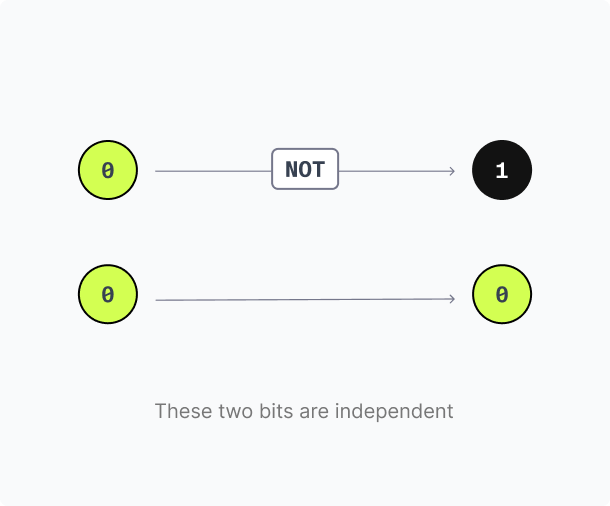
CLASSICAL
Classical bits ARE LOGICALLY, NOT PHYSICALLY, DEPENDENT on other bits
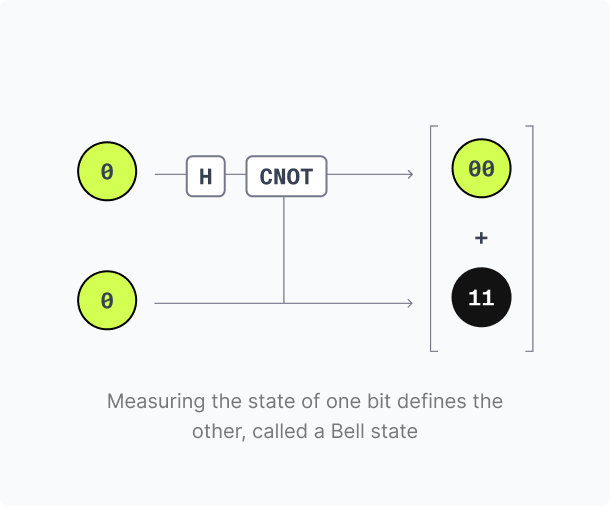
QUANTUM
The STATE OF ONE QUBIT in an entangled pair CAN AFFECT THE OTHER, EVEN SEPARATED BY DISTANCE
Interference
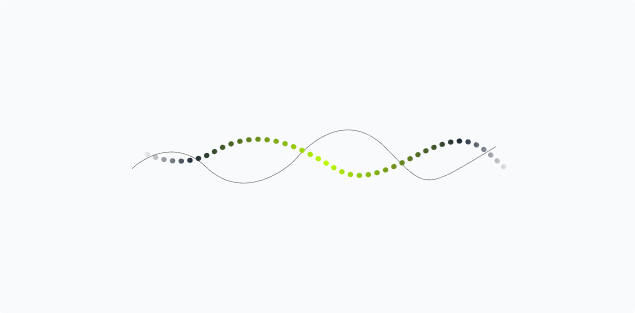
In classical systems, outcome probabilities are positive, and sum to one. But in quantum mechanics, amplitudes (the components of the wavefunction) can be both positive AND negative, and thus interfere with each other before measurement. These amplitudes can reinforce (constructive interference) or cancel out (destructive interference), depending on their relative phases. Quantum computers exploit this phenomenon to “steer” a computation toward correct answers.
Instead of just exploring all paths in parallel, a quantum algorithm is designed so that wrong answers interfere destructively and cancel out, while desirable paths leading to right answers interfere constructively and dominate the final result, providing a unique advantage over classically randomized approaches.
The above properties are what enable quantum computers to outperform classical ones for certain tasks. By leveraging superposition, entanglement, and interference in just the right way, quantum computers can effectively “parallelize” what would otherwise be a serial classical computation.1
Quantum Interference
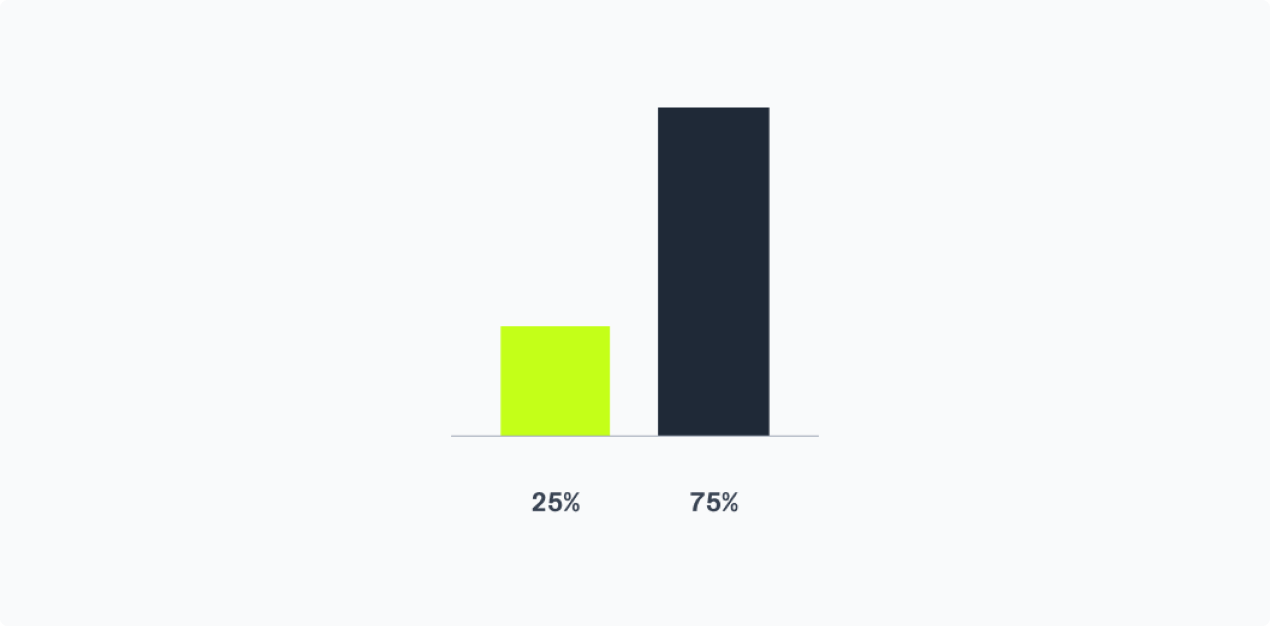
CLASSICAL
Classical computation CAN ONLY REPRESENT PROBABILITIES THAT SUM TO ONE
QUANTUM
Quantum states are waveforms that have POSITIVE and NEGATIVE amplitudes that CAN COMBINE TO AMPLIFY THE RIGHT ANSWER
Quantum Challenges
However, certain quantum mechanical properties also present challenges to realizing a quantum computer in practice.
No-Cloning Theorem
Unlike a classical computer, it is impossible to “copy” quantum states. This no-cloning theorem makes the implementation of low-level primitives that we take for granted in classical computing (like memory registers) much more complex in practice. Instead, operations like quantum teleportation and entanglement swapping must be used to safely transmit or share quantum information across the system during computation.
Measurement Collapse
Critically, in classical computing, measurement is passive (reading memory doesn’t change it). But in quantum mechanics, the act of measuring a system collapses a superposition into a definite state. To gain meaningful advantage from a quantum computer, that superposition must be carefully preserved until the right moment.
Probabilistic & Fragile
The nature of the quantum mechanical wavefunction that describes reality at small scales is inherently probabilistic. Any unintended interaction (even an accidental subatomic interaction) can replicate the effect of a measurement, instantly destroying this fragile system of probabilities into definite states and removing the advantages of quantum computation described above. Thus, the theoretical potential of a fault-tolerant quantum computer is almost matched by the daunting engineering challenges involved in practically building one.
Despite the challenges, quantum computing remains an area of intense research interest because it enables a much more powerful computational paradigm. Whereas the resources required to represent a complex system (such as individual molecules in a fluid) might overwhelm even the most powerful classical hardware, quantum computers can harness superposition and entanglement to solve these otherwise intractable problems, including those that form the basis for modern cryptosystems.